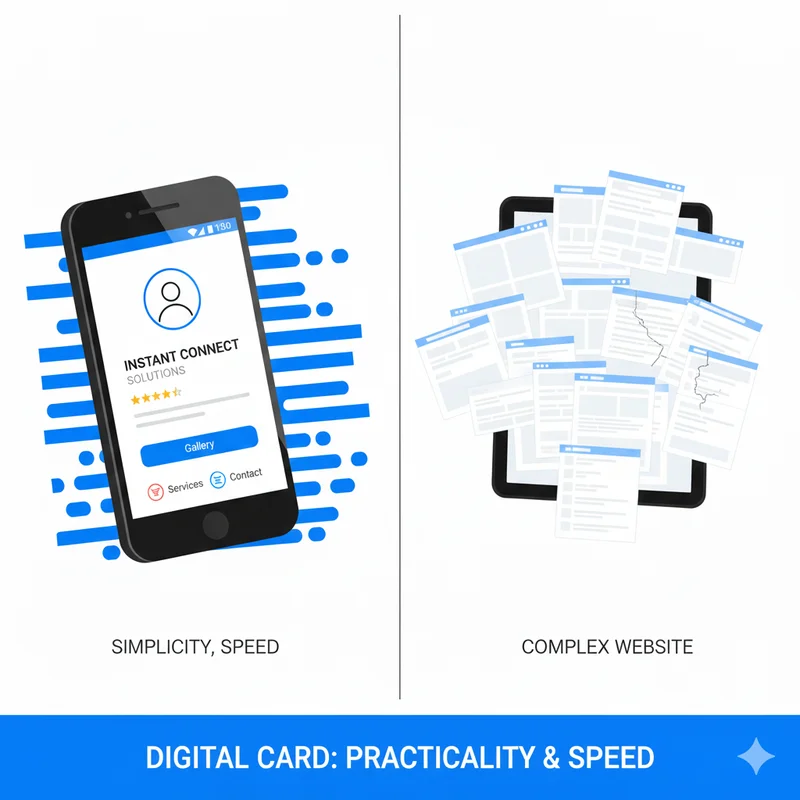
Introduction
For many years, many business owners have relied on business websites to showcase professionalism and be the main source of information about their company or services for potential customers. Business websites provide a digital space for a business to be located, which has now shifted with the change in the way people discover and interact with businesses today, especially for India's small- and micro-businesses.
Today's customers are demanding quick access to services, clear descriptions of what they offer, and the ability to contact the company without scrolling through numerous pages or reading extensive paragraphs of information before finding a business phone number or understanding basic service descriptions. In many cases, having a full business website can create more problems than it solves by requiring customers to go through too many steps to learn what they need.
This has created a niche where digital business cards can offer a much more practical option for many businesses than traditional websites. Digital business cards were designed to be combined with the everyday experience of face-to-face interaction and provide customers with fast, simple, and easy access to their services. This article will provide a detailed breakdown of the ways in which digital business cards outperform business websites from a practical standpoint, specifically for service-based, local, and small business owners.
The Way Customers Actually Discover Businesses Today
Most customer journeys do not begin with typing a full website address.
They begin with a referral, a WhatsApp message, a Google result, or a casual conversation. In these moments, customers want immediate clarity, not a deep browsing experience.
Digital cards fit perfectly into this behavior. They open instantly, show essential information clearly, and do not demand time or effort from the user. Websites, on the other hand, are often designed for exploration rather than quick understanding.
Why Websites Often Feel Too Heavy for Simple Needs
Websites are built to handle many possibilities.
They include multiple pages, menus, banners, forms, and content sections. While this is useful for large businesses, it can feel excessive for customers who only want basic information.
When someone just wants to know who you are, what you do, and how to contact you, a website can feel unnecessarily complex. Digital cards remove this complexity by focusing only on what matters most.
How Digital Cards Respect the Customer’s Time
Time is the most valuable currency today.
Digital cards are designed to respect this by delivering information instantly. There is no loading delay, no navigation confusion, and no distraction.
Customers appreciate tools that make things easy. When they feel their time is respected, they respond more positively to the business.
Why Mobile Experience Makes Digital Cards More Practical
Most local business interactions happen on mobile phones.
Websites often struggle on mobile. They load slowly, display awkwardly, or require zooming and scrolling. Digital cards are built with mobile-first thinking.
They open smoothly, fit perfectly on small screens, and are easy to interact with. This makes them far more practical for everyday use.
How Digital Cards Simplify First Impressions
First impressions happen quickly.
When someone opens a digital card, they immediately see a clear and focused presentation of the business. There is no confusion about where to click or what to read.
Websites sometimes dilute first impressions with too much information upfront. Digital cards keep the introduction simple and confident.
Why Digital Cards Are Easier to Share Than Websites
Sharing is a key part of business growth.
Websites are not always easy to share in casual conversations. People hesitate to forward long URLs or explain where to click.
Digital cards are made for sharing. One simple link can be forwarded instantly through messaging apps, making them more practical for referrals and introductions.
How Digital Business Cards Make Managing Your Business Easier
Websites require regular maintenance to keep running smoothly, such as software updates, hosting, design changes, and troubleshooting issues. This can put an unneeded strain on a small business to keep up with this ongoing maintenance of their website.
Digital business cards are much easier to maintain, as changing/making updates is a simple process, and having a minimal amount of technical issues should provide much less difficulty than a website. Digital cards provide business owners with the ability to manage their businesses without having to worry about the upkeep of their website.
How Digital Cards Facilitate Quick Decisions
Since customers tend to make quick decisions, they need to have the confidence to pick up the phone, send them an email, or ask a question via an online chat. Digital cards give them that confidence with the immediate presentation of clear contact information and an outline of all of the services that they are offering.
Websites tend to create a layer of indecision, by providing many pages and menus to navigate through before being able to locate the correct place where they can make their decision.
How Digital Cards Decrease the Likelihood of Losing A Customer
Any time a customer must go through an additional step to complete their transaction, their likelihood of dropping out of that process increases. Many times, the websites will have customers performing one additional step to find the right page or link to get the information to reach the business owner.
Digital cards help decrease customer friction by keeping customers engaged and allowing them to remain excited about the services that a business owner is providing.
Why Digital Cards Feel More Personal Than Websites
Websites can feel formal and distant.
Digital cards feel more personal, almost like a modern version of a visiting card. They create a sense of direct connection rather than corporate distance.
This personal feel works especially well for service-based and local businesses.
How Digital Cards Support Offline-to-Online Transitions
Many business interactions start offline.
A meeting, a conversation, or a referral often leads to online follow-up. Digital cards make this transition smooth.
Instead of asking customers to search for a website, businesses can share a digital card instantly, keeping interest alive.
Why Digital Cards Are Cost-Effective for Small Businesses
Building and maintaining a good website can be expensive.
Digital cards offer a far more affordable way to establish a strong digital presence. They deliver practical value without heavy investment.
This cost-effectiveness makes them ideal for micro and small businesses.
How Digital Cards Improve Information Clarity
Clarity builds trust.
Digital cards present information in a focused way that avoids overload. Customers know exactly what they are looking at.
Websites sometimes confuse visitors with too many messages at once.
Why Digital Cards Work Better for Service-Based Businesses
Service businesses rely heavily on trust and communication.
Digital cards allow service providers to present themselves clearly and professionally without overwhelming customers.
This simplicity supports faster relationship-building.
How Digital Cards Reduce Dependency on Technology Skills
Websites often require technical knowledge to manage.
Digital cards are simpler to use and update. This reduces dependency on developers or designers.
Practical tools should not require technical expertise.
Digital Cards Have A Greater Versatility By Comparison With Websites
Websites Have Fixed Structures
Digital Cards Are Easy To Use Across Multiple Environments Such As Chats, Emails, Offline Referrals, And Search Results.
The Versatility Of Digital Cards Increases Their Value To Businesses.
Digital Cards Make It Easy For Businesses To Organize Their Online Presence
Businesses That Are Disorganized Online Can Create A Headache For Customers Trying To Find Information.
Digital Cards Provide Easy Access To Business Data In One Place,
Which Makes Businesses Appear Organized, Trustworthy And Professional To The Customer.
The Organization Of Data Is An Important Part Of The Digital Card's Utility.
Digital Cards Are Well Suited To The Ways People Use Their Attention Today
People Tend To Skim Rather Than Study Material Currently Available Via The Internet.
Digital Cards Are Designed For Quick Learning And Easy Access To Business Information.
Because Digital Cards Are Designed To Be Quick And Easy To Use, They Are In Line With Human Behavior.
How Digital Cards Reduce Communication Friction
When information is clear, communication improves.
Digital cards reduce repeated questions and misunderstandings. This saves time for both customers and businesses.
Less friction means better conversations.
Why Digital Cards Are a Smarter First Step Than Websites
Not every business needs a website immediately.
Digital cards provide a strong starting point. They allow businesses to establish credibility and clarity before investing in larger digital assets.
This phased approach is more practical.
How Digital Cards Support Consistent Branding
Consistency builds recognition.
Digital cards ensure that customers see the same information every time, regardless of how they discover the business.
Websites sometimes get outdated or inconsistent.
Why Digital Cards Feel More Natural in Daily Use
Digital cards integrate seamlessly into everyday communication.
They feel like a natural extension of how people already share information. Websites often feel like a separate destination.
Practical tools blend into daily habits.
Conclusion
Business websites are not obsolete, but they are not always the most practical solution, especially for small and micro businesses. In a world driven by speed, simplicity, and mobile interactions, digital cards offer a more efficient way to communicate and connect.
Digital cards focus on what truly matters: clarity, accessibility, and ease of use. They reduce friction, save time, and support faster decisions. For many businesses, they deliver more practical value than a traditional website.
Choosing practicality over complexity allows businesses to meet customers where they are and communicate in a way that feels natural, modern, and effective.
Frequently Asked Questions
Are digital cards better than websites for small businesses?
For quick communication and clarity, yes, they are often more practical.
Can digital cards replace websites completely?
They can serve as a strong alternative or starting point, depending on business needs.
Do customers prefer digital cards over websites?
Customers prefer whichever option saves time and feels easier to use.
Are digital cards suitable for mobile users?
Yes, they are designed primarily for mobile access.
Do digital cards require technical knowledge to manage?
No, they are simple to update and maintain.
Are digital cards cost-effective compared to websites?
Yes, they are generally far more affordable and easier to manage.