Introduction
Amidst the vigor of Indian markets, the voices of small vendors beckoning customers and the colors of fresh fruits invite you around every corner. With intense competition and thin margins, small vendors often feel modern technology is reserved for the operational environments of malls, not mandis. However, one fruit vendor in Pune demonstrated that innovation has more to do with mindset than size of business.This is the inspirational story of Ramesh Kumar, the roadside fruit vendor who, through QR code payments, was able to expedite transactions, cultivate trust with customers, and grow his small business quicker than anyone thought possible. Through interesting use of digital tools, local visibility platforms (like LocalShouts (https://www.localshouts.com)), and genuine understanding of customer consumption patterns, Ramesh manifested the fruit stall of the future for small businesses.
Let’s find out how this simple, yet deliberate, improved his business — and what other small business owners can take note.
The Humble Beginning
Ramesh Kumar, 37, ran a small fruit stall near Pune’s Kothrud area. Every morning, he would load bananas, apples, and seasonal fruits onto his cart from the wholesale market and set up shop by 8 AM. His customers were mostly office-goers, students, and elderly residents of nearby housing societies.
Like many local sellers, he dealt mostly in cash. But daily problems kept piling up:
- Customers often didn’t have change for ₹50 or ₹100 notes.
- Small losses occurred due to miscalculations.
- Handling cash during the pandemic made buyers cautious.
Ramesh realized he was losing potential customers — not because of his fruits, but because of payment inconvenience.
The Turning Point: A Very Simple Observe
One day — a college student came to purchase fruits worth ₹80 and said, "Bhaiya I don't have cash, do you have Google Pay?"
Ramesh shook his head, and the student walked away. That tiny incident led to a thought:
"If my customers are ready to pay digitally, why shouldn't I make it easier for them?"
The next day Ramesh asks the nearby tea vendor how they are using QR codes to handle payments. Within a few hours, he had a sticker setup to accept QR payments, through the UPI account linked to his bank.
This one minor step—I mean printing and sticking up a QR code—will change his entire business.
Process step 1: Setting up QR payments
Ramesh wanted to keep things simple.
He opened an account through PhonePe and Google Pay using his savings account.
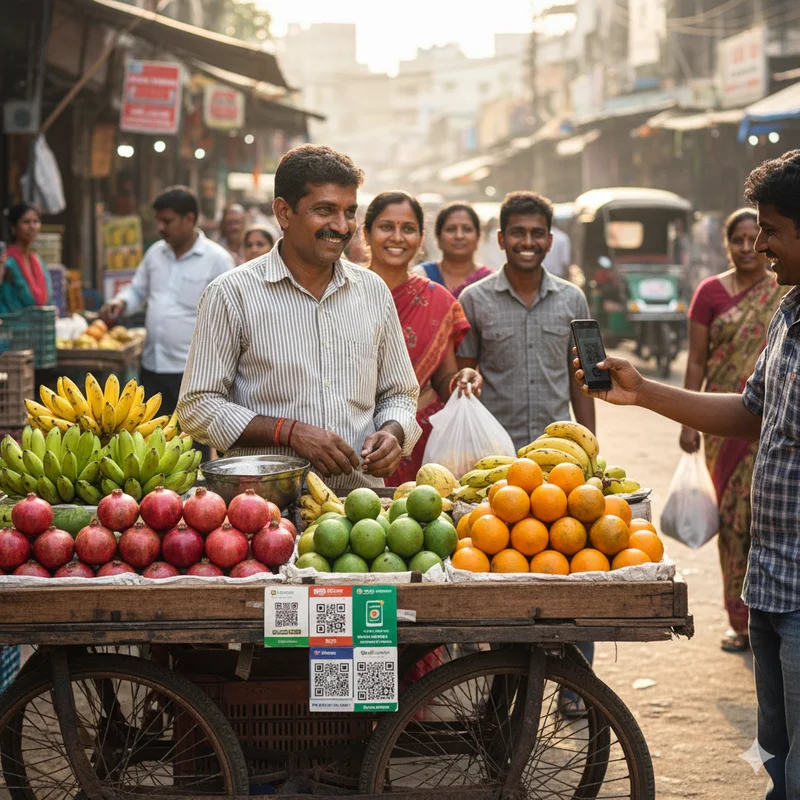
He had 2 QR codes printed and laminated to clearly show the customers on his fruit stand.
He kept one on a cart, and the other by the scale, so it was easily accessible whenever he weighed a fruit for the customer.
The first few days it was quiet, a few customers noticed, but it did not disrupt the habit of cash. But steadily, predominantly the younger customers started using UPI payments, and eventually, the practice spread.
In approximately two weeks, if you were to look at Ramesh's daily transaction in the beginning, today you would find the percentage of transactions via QR payments would be approximately 60%.
Step 2: Building Trust Through Transparency
Digital payments did more than simplify transactions — they built trust.
Many new customers, especially women and elderly buyers, appreciated the transparency of digital payments. There was no risk of getting a wrong change, and every transaction showed instantly on Ramesh’s phone.
He also started using the Google Pay business dashboard, which displayed daily summaries. That helped him track income, identify peak hours, and even calculate profit more accurately.
Step 3: Reducing Cash Handling and Errors
Earlier, Ramesh spent 30–40 minutes daily counting cash, organizing notes, and worrying about theft. Now, with QR payments, he had:
- Zero counterfeit currency risk
- Instant notifications for every payment
- No confusion about pending balances
At the end of each day, his earnings directly reflected in his bank account — no manual counting needed.
For a small business owner, this was revolutionary. It saved him time, reduced stress, and made his operation far more professional.
Step 4: Using Digital Receipts as Marketing
Ramesh noticed that each UPI transaction showed his business name, “Ramesh Fruits Stall,” along with a small message option. He decided to use it creatively.
He updated his business name on Google Pay as “Ramesh Fruits – Fresh Every Morning” and added a thank-you note after each payment:
“Thank you for supporting local sellers! Visit again for sweet Nagpur oranges 🍊”
Customers started noticing his name, and some even saved his contact for future orders. Soon, regular buyers began sending him WhatsApp messages: “Bhaiya, please keep two kilos of apples ready.”
Ramesh had unintentionally built a digital relationship with his customers.
Step 5: Expanding Reach Through LocalShouts
A few months later, a young techie who regularly bought fruits suggested that Ramesh list his business on LocalShouts (https://www.localshouts.com) — a platform that helps small and micro businesses in India become more discoverable online.
With help from his son, Ramesh created a free business listing on LocalShouts. He added:
- His shop name: “Ramesh Fruits Stall – Kothrud”
- Daily open hours
- Product highlights (fresh fruits, seasonal mangoes, cut fruit bowls)
- QR payment availability
- A contact number for home delivery
Soon, when people nearby searched “fruit shops near me,” his listing started appearing with verified contact and location.
Within two weeks, he began getting 3–5 new customers daily who discovered him online.
That’s when Ramesh realized — digital presence matters, even for street vendors.
Step 6: Leveraging QR Codes for Promotions
Encouraged by the results, Ramesh took another innovative step. He printed custom QR flyers and handed them to nearby offices and apartments.
The flyers said:
“Order Fresh Fruits on WhatsApp – Pay Instantly via QR. Free Delivery for 1km Radius!”
He started getting regular orders from office employees who preferred paying digitally.
He combined digital payments with LocalShouts visibility, allowing both walk-in and remote customers to connect easily.
Step 7: Cultivating Customer Loyalty
The ease of payment via QR made it more likely for his customers to return to him. Ramesh also utilized UPI "Payment Notes" to keep track of his repeat customers, which allowed him to choose when to suggest minor discounts occasionally.
As an example, he offered one regular customer who returned to pay via UPI ten times a free bowl of fruits. This was an inconsequential gesture that customers loved, so much so that many referred their friends to this vendor.
He quickly began to think of himself as someone who was not only selling fruit but also building relationships — forging connections based on trust and ease of payments.
Step 8: Entry into the Financial System and Getting Access to Loan.
Through increased digital sales, Ramesh’s UPI account history began to be proof of income.
When he went to his local bank, they offered small business loans and he had an idea to map out the payback option based on the banker's offer, he would use UPI account statements as steady income when he bought his small cart to expand the location. The banker was impressed -- Ramesh's ongoing digital records provided assurance of activity and proof of income turnover.
Once approved for a small ₹50,000 micro-loan Ramesh's quickly applied funds included a new canopy, weighing machine, and better fruit display baskets.
Not only does this mark the step towards his evolution from the vendor to a digitally-enabled small entrepreneur.
Step 9: Expanding During Festivals
Festivals like Diwali and Navratri bring high fruit demand. Ramesh used his LocalShouts listing and WhatsApp catalog to announce offers such as:
“Buy 5kg fruits, get ₹50 off on QR payment!”
He shared the LocalShouts link with customers and posted short messages in nearby resident WhatsApp groups.
This digital push helped him attract bulk orders for fruit baskets — something he never imagined before going digital.
During one Diwali season, he earned 30% higher revenue compared to previous years.
Step 10: Inspiring Other Vendors
Ramesh’s success caught the attention of other street vendors. Nearby vegetable sellers, flower stall owners, and tea vendors began asking him how to set up QR codes and LocalShouts profiles.
He gladly helped them, explaining:
“When customers find it easy to pay, they come again. And when they find you online, they bring new customers too.”
Soon, an entire lane of small vendors in Kothrud adopted QR codes — creating a digitally friendly local marketplace.
Lessons from Ramesh’s Story
- Technology isn’t just for big businesses. Even a fruit seller can use digital tools to simplify life and grow sales.
- Convenience builds loyalty. When customers can pay easily, they come back more often.
- Digital records create financial credibility. UPI history can help access loans and government support.
- Visibility platforms like LocalShouts amplify reach. They make small vendors discoverable in their local areas.
- Innovation starts with observation. Ramesh didn’t attend any workshop — he simply noticed customer behavior and adapted.
How LocalShouts Supported Growth
LocalShouts (https://www.localshouts.com) became a turning point in Ramesh’s journey. It gave his business:
- Authentic online presence verified for local searches.
- Direct communication with customers through integrated contact options.
- Visibility in his community, boosting walk-in and delivery orders.
For small sellers like Ramesh, LocalShouts is more than a directory — it’s a gateway to digital discovery. When people search “fruit vendors near me” or “fresh fruits in Kothrud,” Ramesh’s listing ensures he’s found first.
The Bigger Picture: India’s Digital Payment Revolution
Ramesh’s story isn’t isolated. Across India, small and micro businesses — tea stalls, kirana shops, barbers, and vegetable sellers — are embracing QR payments.
According to RBI data, UPI transactions have crossed 14 billion per month, with millions of small merchants benefiting. QR codes have become the great equalizer — giving every vendor, no matter how small, a tool to accept payments like a professional.
By combining QR technology with digital presence platforms like LocalShouts (https://www.localshouts.com), small vendors can now compete, grow, and build long-term customer trust.
Future Plans for Ramesh Fruits
With his business stable and digitally empowered, Ramesh now plans to:
- Start fruit delivery for offices nearby.
- Collaborate with other local vendors listed on LocalShouts for cross-promotion.
- Launch a “Healthy Office Snack Box” subscription model with digital ordering.
For someone who once feared technology, he now uses it daily — not just to collect payments, but to build a sustainable business.
Conclusion
Ramesh Kumar’s journey from a simple fruit cart vendor to a tech-savvy small entrepreneur proves that innovation begins with curiosity. By embracing QR payments, he removed friction from transactions. By joining LocalShouts (https://www.localshouts.com), he ensured customers could find him online.
His story is a blueprint for small business owners across India:
“You don’t need a big budget to grow — just a smart idea, and the courage to try.”
Today, his stall stands as a symbol of India’s digital transformation, where even the smallest businesses can thrive through technology, trust, and customer connection.
FAQs
1. How can small vendors start accepting QR payments?
They can link their bank account to UPI apps like Google Pay, PhonePe, or Paytm and generate a QR code to display at their shop.
2. What are the benefits of using QR payments for small businesses?
It reduces cash handling, improves accuracy, builds trust, and helps track earnings automatically.
3. How did LocalShouts help Ramesh’s fruit stall?
LocalShouts (https://www.localshouts.com) increased his visibility, helped nearby customers discover his stall, and supported online ordering.
4. Are QR payments safe for small vendors?
Yes, UPI transactions are encrypted and secure. Always verify payment notifications before handing over products.
5. Can digital payments help vendors get loans?
Yes. Consistent UPI transaction history can serve as financial proof when applying for micro-loans or government schemes.
6. What advice does Ramesh have for other small business owners?
Start small, learn from customers, and don’t be afraid of digital tools. Even simple steps like QR codes or LocalShouts listings can bring huge change.